
Surprising fact: nearly one in four drivers face an unexpected repair bill in the first three years of ownership, and the cost often exceeds $1,000.
You need clear guidance when choosing a vehicle service warranty that fits your car, mileage, and budget. This piece compares two leading options and shows where maintenance credits, roadside assistance, and rental reimbursement can change your total cost.
Quick snapshot: one provider includes a 13‑month maintenance program with set credits for oil changes, brakes, battery, and cooling service plus 24/7 roadside help. It also offers rental reimbursement ($30/day up to $150) and trip interruption benefits, with eligibility up to 15 model years and 250,000 miles.
Claims require pre-authorization and some shops can be paid directly. Ratings matter: BBB accreditation and Trustpilot scores give you clues about real-world service and claim outcomes.
Key Takeaways
- Check plan tiers and coverage definitions to know what repairs are truly included.
- Maintenance credits and roadside assistance can lower ownership costs over time.
- Eligibility by year and mileage helps you rule out options quickly.
- Pre-authorization and repair shop rules affect payment speed and convenience.
- Compare BBB and review scores to gauge claims handling and customer support.
- Balance deductible, payment terms, and features to estimate long-term value.
What you’re really comparing when you weigh vehicle service contracts in the United States
Picking the right vehicle service contract means reading the fine print, not trusting the logo on the ad.
You’re comparing definitions of what is covered and what is excluded. Industry averages in 2024 put extended car warranty costs near $2,200–$2,800, so coverage detail matters for value.
Look at whether a plan is stated or exclusionary. That affects which parts are paid and how clearly the contract lists components.
Tip: check waiting periods, mileage limits, and whether maintenance items are included or excluded.
- Compare how providers handle claims: pre-authorization, inspections, and direct payment to shops.
- Factor in roadside assistance, rental support, and trip interruption to lower out-of-pocket costs.
- Verify transferability, cancellation terms, and whether OEM or aftermarket parts apply.
Read reviews, BBB ratings, and Trustpilot feedback for customer service trends. Third-party companies such as Endurance, Toco, Everything Breaks, autopom!, and Olive are common options to compare on coverage, cost, and buying experience.
Quick comparison snapshot to match your needs today
This quick rundown highlights the practical differences that matter on the road today.
Short summary: one provider includes 24/7 roadside assistance, rental reimbursement, and trip interruption ($75/day up to 3 days) on all plans and supports vehicles up to 15 model years or 250,000 miles. The other commonly uses an exclusionary structure aimed at newer cars still close to factory warranty limits. You’ll pick the best warranty by matching coverage to your car’s age and mileage.
At-a-glance strengths
- Coverage options: broad roadside and travel benefits on every tier improve daily reliability.
- Maintenance benefits: added credits and road hazard protection reduce out-of-pocket repairs.
- Roadside assistance: 24/7 help and rental allowances keep you moving after a breakdown.
- Trip interruption: helps cover unexpected lodging and meals during travel delays.
Which suits older, high‑mileage vehicles vs. newer cars
If your car has higher mileage or is older, plans that allow eligibility to 15 model years and 250,000 miles provide more value. These options often include maintenance perks and travel benefits that lower ownership cost.
For newer cars, an exclusionary plan can offer tight mechanical definitions and may be cheaper if the factory warranty still covers major systems. Always validate eligibility, exclusions, and how each plan defines covered parts to avoid surprises.
Quote: “Match the plan to your driving patterns — a broader travel and roadside package matters more if you drive long distances or own an older vehicle.”
| Feature | Best for older/high‑mileage vehicles | Best for newer cars | Why it matters |
|---|---|---|---|
| Eligibility | Up to 15 years / 250,000 miles | Often limited to newer model years | Determines if your vehicle can enroll |
| Roadside assistance | 24/7 included on plans | May be add-on or limited | Reduces out-of-pocket costs at breakdown |
| Trip interruption | $75/day up to 3 days standard | Varies; check limits | Protects travel expenses after failures |
| Coverage style | Stated or broad stated options | Commonly exclusionary structure | Impacts claim approvals and clarity |
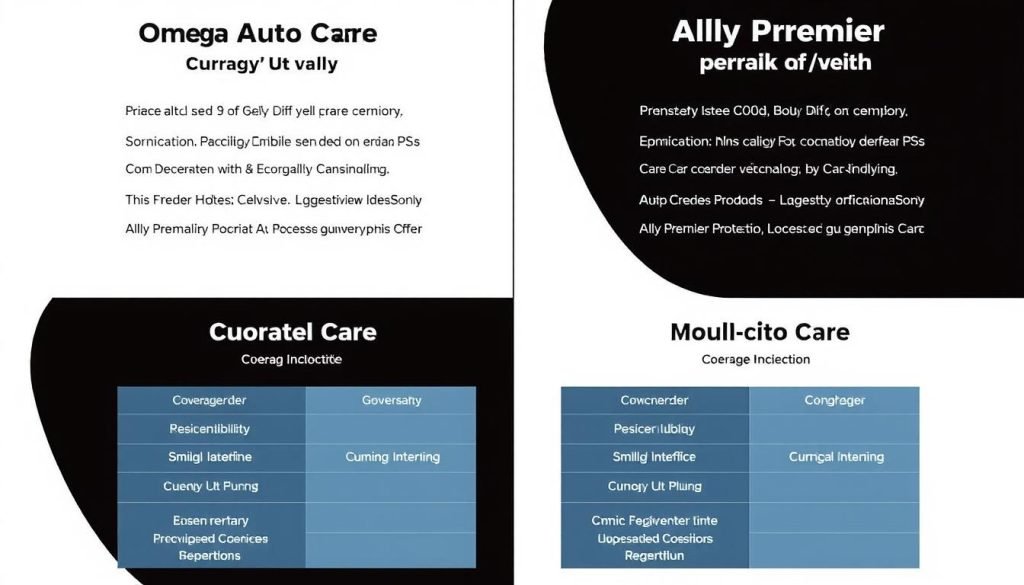
Omega Auto Care vs. Ally Premier Protection: core coverage options and plan tiers
Knowing which systems a plan names prevents surprises when a claim arrives.
Omega’s tier ladder starts with Powertrain (engine, turbo/supercharger, transmission, transfer case, drive axle). Powertrain Enhanced adds limited electrical, A/C, and heating items. Powertrain Plus expands coverage to cooling and fuel systems. The Used Stated tier covers most component systems — steering, suspension, fuel, and brakes — while the Exclusionary option repairs almost all systems except listed exclusions.
All tiers include 24/7 roadside assistance, tire road hazard protection (up to $100 per occurrence, $400 max), rental reimbursement ($30/day, $150 max), and trip interruption ($75/day up to 3 days).
How exclusionary and stated structures change repairs
With a stated contract, covered parts are listed and paid when named. With an exclusionary contract, everything is covered unless it’s listed as excluded. That difference affects claim approvals and what you pay for worn or maintenance-related items.
Tip: read the component list in the contract and keep service records to avoid denials for lack of maintenance.
Common exclusions and practical checks
Providers typically exclude pre-existing conditions, negligence, and failures caused by missed maintenance. Wear-and-tear items and fluids often need explicit mention to be covered.
Before you buy, verify pre-authorization rules, inspection requirements, and whether the provider offers direct-pay to repair shops. For a side‑by‑side sample, see this sample contract comparison.
| Plan tier | Key systems covered | Best for | Why it matters |
|---|---|---|---|
| Powertrain | Engine, transmission, drive axle, transfer case, turbo | Drivers wanting core mechanical protection | Protects the most costly failures |
| Powertrain Enhanced / Plus | Adds electrical, A/C, heating; Plus adds cooling and fuel | Owners needing mid-level electrical and cooling coverage | Covers systems that commonly fail after factory warranty |
| Used Stated | Steering, suspension, brakes, fuel systems, broad components | Older or higher-mileage vehicles | Extends protection to many wear-prone systems |
| Exclusionary | All systems except listed exclusions | Newer cars where exclusions are narrow | Simpler claims if the part is not on the exclusion list |
Added benefits that tilt value: rental car reimbursement, roadside assistance, and trip interruption
Added benefits — like roadside aid, rental help, and trip interruption — often decide whether a warranty truly saves you money.
Quick view: supplemental perks reduce out-of-pocket shocks when a breakdown happens away from home.
What the 24/7 help includes
The plan delivers roadside assistance with towing, jump-starts, lock-out service, flat-tire help using your spare, and fluid delivery.
It adds concierge support for up to three calls and reimbursement up to $100 per occurrence for eligible services.
Rental, trip, and tire protections
Rental car reimbursement pays up to $30 per day, $150 max per occurrence. Trip interruption covers $75 per day for up to three days when you are 100+ miles from home due to a covered failure.
Road hazard tire protection reimburses up to $100 per tire and $400 total per event.
- How to file: keep receipts, get pre-authorization when required, and submit paperwork quickly to speed payment.
- Compare these benefits to industry norms and reviews to judge whether the added cost of higher-tier plans offsets travel and downtime losses.
Maintenance benefits and ongoing vehicle care
Including routine service credits with a warranty changes how you budget for car ownership. Small, scheduled services reduce repair risk and smooth out your annual cost.
What the 13‑month maintenance program includes
After a 30‑day waiting period, the program runs 13 months and covers specific credits and services.
- Up to three oil changes: $40 each (or $55 for synthetic).
- $100–$130 toward brake pads/shoes on select cars.
- $100 battery credit and one cooling system service up to $40.
- Wiper blade replacement (up to 20″) and one safety inspection.
How these perks affect total cost
Documentation matters: submit invoices within 45 days; processing takes about 3–4 weeks.
These maintenance benefits offset routine expenses and can lower your overall cost of ownership when compared to standard auto warranty plans that exclude service. Track mileage and seasons to use credits efficiently, and weigh convenience against any higher premium when you choose plans with bundled service.
Eligibility, mileage, and vehicle age: will your car qualify?
Before buying coverage, confirm that your vehicle’s age and mileage fit the plan limits you’re considering. A quick check narrows options and helps you avoid surprises at claim time.
- Powertrain: up to 15 model years and 250,000 miles for core warranty policies.
- Used Stated: generally up to 10 model years and 150,000 miles for broader stated coverage.
- Exclusionary: usually applies to newer cars (about 7 model years) with tight definitions.
Not eligible: vehicles over 15 years, antique or exotic cars, commercial-use cars (taxis, rentals), salvage titles, odometer tampering, and cars still under a manufacturer’s basic warranty.
How to apply this to your decision
Map your car to the right tier, watch mileage thresholds that change pricing, and gather service records to support future claims. Compare contracts and read reviews of companies to see real-world service and coverage outcomes.
| Check | Why it matters | Action |
|---|---|---|
| Model year & mileage | Determines which plans you can buy | Verify odometer and birth year |
| Factory warranty | May exclude third‑party enrollment | Delay purchase until factory coverage ends |
| Title & use | Salvage or commercial use can void coverage | Confirm title status and past use |
Claims process and customer experience: speed, transparency, and approvals
When a breakdown happens, a smooth claims path decides whether you leave the shop with a paid bill or a large out-of-pocket cost. This section walks you through the steps to file a claim and what to expect from start to finish.
How claims work at the repair shop
Your shop must call for pre-authorization before work begins. That call starts the approval flow and prevents delays or denials.
A standard $100 deductible applies per repair visit.
If you use a RepairPal-certified shop, that deductible may be waived. Omega Auto Care pays approved claims directly to the facility after confirmation and invoice submission.
Inspections, emergency repairs, and roadside ties
The administrator can request third‑party inspections and may relocate the vehicle to another shop if needed. For emergency repairs, contact the provider as soon as possible to document the issue.
When a tow is involved, roadside assistance links to the claim process so towing invoices and diagnostics move through approval together.
Tip: keep estimates, invoices, photos, and service records handy to speed approvals and avoid disputes.
Check reviews to gauge real-world turnaround on approvals, denials, and customer service. Ask about OEM vs. aftermarket parts and labor rates so you know what coverage and plans actually pay at repair time.
Pricing, deductibles, and long‑term cost of coverage
Understanding true long‑term cost means looking beyond monthly payments to total dollars paid and benefit limits.
Benchmarking price: industry averages in 2024 run about $2,200–$2,800 for an extended car warranty. Some customer reports show higher quotes—examples include a New Exclusionary contract near $3,705 and a Powertrain Plus quote around $4,657 with a $495 down payment.
How payment terms and deductible choices change what you pay
Monthly plans from other providers provide contrast. Endurance sample quotes range $138–$203/month with a $100 deductible on longer terms. Toco shows lower monthly pricing near $79/month with a $100 deductible and flexible month‑to‑month terms. Olive quotes for a 2017 model at 110,000 miles run about $120–$171/month with a $500 deductible for 36 months.
- Deductible tradeoff: $100 vs. $500 choice can lower monthly price but raise claim‑day expense.
- Down payments: a larger down payment often cuts financing cost and total paid over time.
- Benefits vs. price: check if rental car and travel perks offset higher premiums.
Quote: “Ask for itemized quotes that list term length, mileage cap, and benefit limits so you can compare apples to apples.”
| Example | Sample monthly | Deductible | Why it matters |
|---|---|---|---|
| Endurance (sample) | $138–$203 | $100 | Lower claim cost, higher monthly |
| Toco (sample) | $79.05 | $100 | Flexible terms, lower monthly |
| Olive (sample) | $119.98–$171.40 | $500 | Lower monthly, higher out‑of‑pocket per claim |
Before you buy, request itemized pricing and read recent reviews. Compare plans, term lengths, mileage caps, and benefit limits to find the best value for your vehicle and budget.
Reputation, reviews, and ratings: what customers say about warranty companies
Customer reviews reveal how a provider handles claims, complaints, and follow-up — and that matters more than glossy ads.
Key ratings: the company holds an A+ BBB accreditation with a 3.76/5 from 300+ BBB reviews (Apr 2024) and 3.9/5 on Trustpilot from 1,200+ reviewers. For context, Endurance posts an A- BBB and 3.6 Trustpilot; Toco reports A+ with higher Trustpilot scores; other providers vary from strong to weaker Trustpilot marks.
What the reviews usually highlight
Reports cluster around claim speed, clarity of coverage, and customer service tone.
Smooth claims are praised when pre-authorization is clear and shops receive direct payment. Complaints commonly cite denials tied to exclusions or missed maintenance.
Why responsiveness and outcomes matter
Fast, clear communication reduces dispute risk and lowers your out-of-pocket exposure. You’ll want to weigh call-center experiences and whether the administrator handles claims in-house.
“Look for patterns in claim outcomes — a high rating alone won’t protect you from coverage disputes.”
- Compare ratings across companies alongside pricing and coverage.
- Use third-party reviews as a guide, then confirm with sample contracts and written benefit summaries.
- Watch for cancellation, pro rata refunds, and transfer feedback.
| Metric | What to watch for | Why it matters |
|---|---|---|
| BBB score | Accreditation and complaint history | Shows regulatory and dispute handling trends |
| Trustpilot rating | Volume and recent review tone | Reflects customer service and claims experience |
| Common themes | Claims paid vs. denials; communication speed | Predicts real value beyond advertised benefits |
To verify reputation, read detailed reviews and then check a sample contract. You can start your comparison with this coverage comparison to align ratings with written plan terms.
When Omega Auto Care is a better fit—and when Ally Premier Protection may make more sense
Deciding between broad service perks and an exclusionary contract often comes down to how you use your car and where you drive.
If you prioritize maintenance benefits and broad roadside support, pick the provider that bundles a 13‑month maintenance program with credits for oil, brakes, battery, and cooling. Those built-in perks, plus universal roadside assistance, rental reimbursement, trip interruption, and road‑hazard tire credits, lower your out‑of‑pocket costs and simplify routine care.
If you need exclusionary coverage for newer vehicles or different deductible options
Exclusionary-style plans often suit newer cars that benefit from tight “bumper‑to‑bumper” definitions. These plans can be cheaper per month and may list clearer deductible choices. Verify eligible years and makes in the contract and check whether deductible waivers apply at RepairPal or certified shops.
- Maintenance vs. price: weigh included service credits against potentially lower premiums without those benefits.
- Deductible preference: confirm $100 vs $500 tradeoffs and any waived deductible rules.
- Eligibility: match years and mileage to plan limits before you buy.
- Claims convenience: local shop networks and RepairPal ties can speed approvals.
- Travel needs: frequent road trips make trip interruption and rental coverage more valuable.
Quick rule: choose the plan that matches how long you’ll keep the vehicle and how much routine maintenance you want bundled with coverage.
Alternatives to consider if neither option matches your vehicle or budget
If the two main choices don’t fit, consider other providers that offer different pricing, mileage caps, and claims handling. These companies give a range of options from month-to-month billing to direct administration.
Direct administrators and plan highlights
Endurance offers six plans, a maintenance add-on, direct claims handling, 24/7 roadside assistance, rental car and trip interruption. Sample quotes for a 2017 Kia Sportage ran about $138–$203/month with a $100 deductible.
Toco uses month-to-month billing (from $79.05) with $100 deductible and mileage bands up to 250,000. It pays Enterprise rental direct, which simplifies repairs that need a loaner.
Everything Breaks lists four tiers plus Critical Coverage, quoted near $107.89/month, and supports vehicles up to 250,000 miles with direct administration.
autopom! is known for high-touch service and competitive yearly costs; some contracts are administered by other firms but the company keeps a clear plan ladder.
Olive offers simple online plans and fast quotes ($120–$171/month sample). It provides towing reimbursement but limited full roadside or trip interruption and caps odometer eligibility on some terms.
How mileage, rental policies, and buying experience compare
What to watch: compare mileage caps and whether a plan supports very high odometer limits or effectively unlimited mileage. That matters if you drive a lot.
Also weigh rental and towing rules: direct-pay rental credit versus reimbursement can change your out-of-pocket cost. Check online buying ease and review scores to see how claims and communication perform in real life.
Tip: shortlist two or three providers and request sample contracts to compare component lists, deductibles, waiting periods, and benefit limits.
| Provider | Standout feature | Sample quote / limit |
|---|---|---|
| Endurance | Six plans, maintenance option, direct admin | $138–$203/mo; $100 deductible |
| Toco | Month-to-month, Enterprise rental direct | $79.05/mo; up to 250,000 mileage bands |
| Everything Breaks | Flexible eligibility, Critical Coverage option | $107.89/mo; up to 250,000 miles |
| autopom! | High-touch service, clear tiers | Low annual cost in samples; varies by admin |
| Olive | Fast online quotes, simple plans | $120–$171/mo; towing reimbursement only |
For a side-by-side coverage comparison and to read sample contracts, start with this coverage comparison and pull provider sample contracts before you buy.
How to shop smart: comparing contracts, coverage levels, and claims processes
Start by asking for the full sample contract so you know exactly what will and won’t be paid when a breakdown happens.
Read the paperwork and verify sample contracts
Request written contracts from each provider and mark covered parts and exclusions. Compare stated coverage and exclusionary language line by line.
Tip: look for waiting periods, pre‑authorization steps, and inspection rights so the claims process is clear.
Match coverage to your repair risk and mileage horizon
Estimate your likely repairs based on car age, typical mileage, and known model issues. Then pick plans that align with that risk and your maintenance habits.
Quick checklist:
- Request and read sample contracts to confirm exact coverage and exclusions.
- Compare stated vs. exclusionary contract language side‑by‑side.
- Check reviews and BBB/Trustpilot ratings for real claim outcomes.
- Verify deductibles, pre‑auth rules, shop network benefits, and transfer policies.
- Normalize term length, mileage caps, and benefit limits on a comparison worksheet.
- Keep maintenance records to support future claims and avoid denials.
Conclusion
Conclusion
Now that you’ve compared features side‑by‑side, focus on matching plan details to your driving habits and repair risk.
omega auto care offers broad benefits — maintenance credits, roadside assistance, rental reimbursement, and trip interruption — and supports vehicles up to 15 model years and 250,000 miles. Ally tends to target newer cars with exclusionary coverage, so verify deductibles and exclusions before you buy.
Use reviews and sample contracts to confirm claims steps and shop rules. Balance total cost, deductible, and travel benefits, and keep maintenance records. If neither fits, consider other companies like Endurance or Toco as clear alternatives.
When ready, get quotes and read contracts carefully. For an additional comparison, see this protect my car comparison to broaden your options before you decide.